Query Discord Meeting Notes with Natural Language AI
Discover how natural language AI transforms Discord meeting notes into searchable assets, enhancing productivity and decision-making.
Query Discord Meeting Notes with Natural Language AI
Discord lacks native meeting notes for voice channels, and most bots rely on rigid slash commands that make retrieval painful. Natural language AI changes this by letting you query transcripts conversationally—ask "What blockers did the backend team mention?" and get the exact timestamped answer. Harmony's AskHarmony feature enables this workflow, turning Discord transcripts into searchable knowledge that 6,000 users already rely on daily.
TLDR
- Discord has no built-in meeting notes for voice channels, forcing teams to rely on third-party bots that typically use slash commands for basic capture
- Natural language query lets users ask questions in plain English instead of hunting through transcripts or remembering exact keywords
- The technical workflow involves audio capture, transcription with speaker diarization, embedding transcripts into vector databases, and semantic retrieval
- Harmony supports 57+ languages and provides conversational search through AskHarmony, eliminating post-meeting information hunts
- Knowledge workers spend 21.5 hours weekly in meetings, making efficient retrieval critical for productivity
- Future developments point toward agentic AI that will automate entire meeting workflows beyond just answering questions
You finished a 45 minute Discord standup, scrolled through the chat history, and still could not find the one decision that mattered. Sound familiar? Discord lacks a built-in meeting notes feature for voice channels, and most bots that claim to fill the gap stop at slash commands and static summaries. What teams actually need is the ability to ask a plain English question and get the exact clip or transcript snippet back.
This guide explains how natural language search transforms Discord meeting notes from a chore into an asset. You will learn what makes the technology work, how it compares to command driven bots, and how to set up a workflow that lets you query past conversations the way you think about them.
Why does searching Discord meeting notes still feel so painful?
Discord was built for gaming and community chats, not workplace meetings. The platform lacks a built-in meeting notes feature for voice channels. Text based conversation summaries exist as an experimental feature, but they do not cover voice calls at all.
Traditional note takers solve only part of the problem. They record, transcribe, and maybe summarize, yet retrieval still depends on keyword search or manual scrolling. A PwC study found that 35 percent of CEOs felt time spent in decision making meetings was inefficient, and 40 percent felt the same about informational sessions. If finding information after the meeting is just as hard as sitting through it, the inefficiency compounds.
Natural language query flips the model. Instead of remembering exact phrases, you describe what you need and the system retrieves the relevant passage. Harmony's AskHarmony feature lets users query meeting content in conversational language, turning transcripts into searchable knowledge.
Key takeaway: The real bottleneck is not capturing audio; it is surfacing the right information when you need it.
How much productivity do teams gain with natural language queries?
Quantifying the return on AI meeting notes starts with understanding how much time meetings already consume.
| Metric | Value | Source |
|---|---|---|
| Average weekly meeting hours | 21.5 hours per knowledge worker | AssemblyAI |
| Employees reporting improved productivity with AI tools | 81 percent | Slack Workforce Lab |
| Organizations setting efficiency as an AI objective | 80 percent | McKinsey |
Natural language retrieval compounds these gains by eliminating the post meeting hunt. Instead of skimming a 45 minute transcript, you ask "What blockers did the backend team mention?" and the system returns the timestamped answer. Teams that adopt this workflow report faster follow ups and fewer dropped action items.
Key takeaway: The productivity lift from AI meeting notes comes not just from transcription, but from instant retrieval.
What are the building blocks of an AI workflow—from Discord audio to answers?
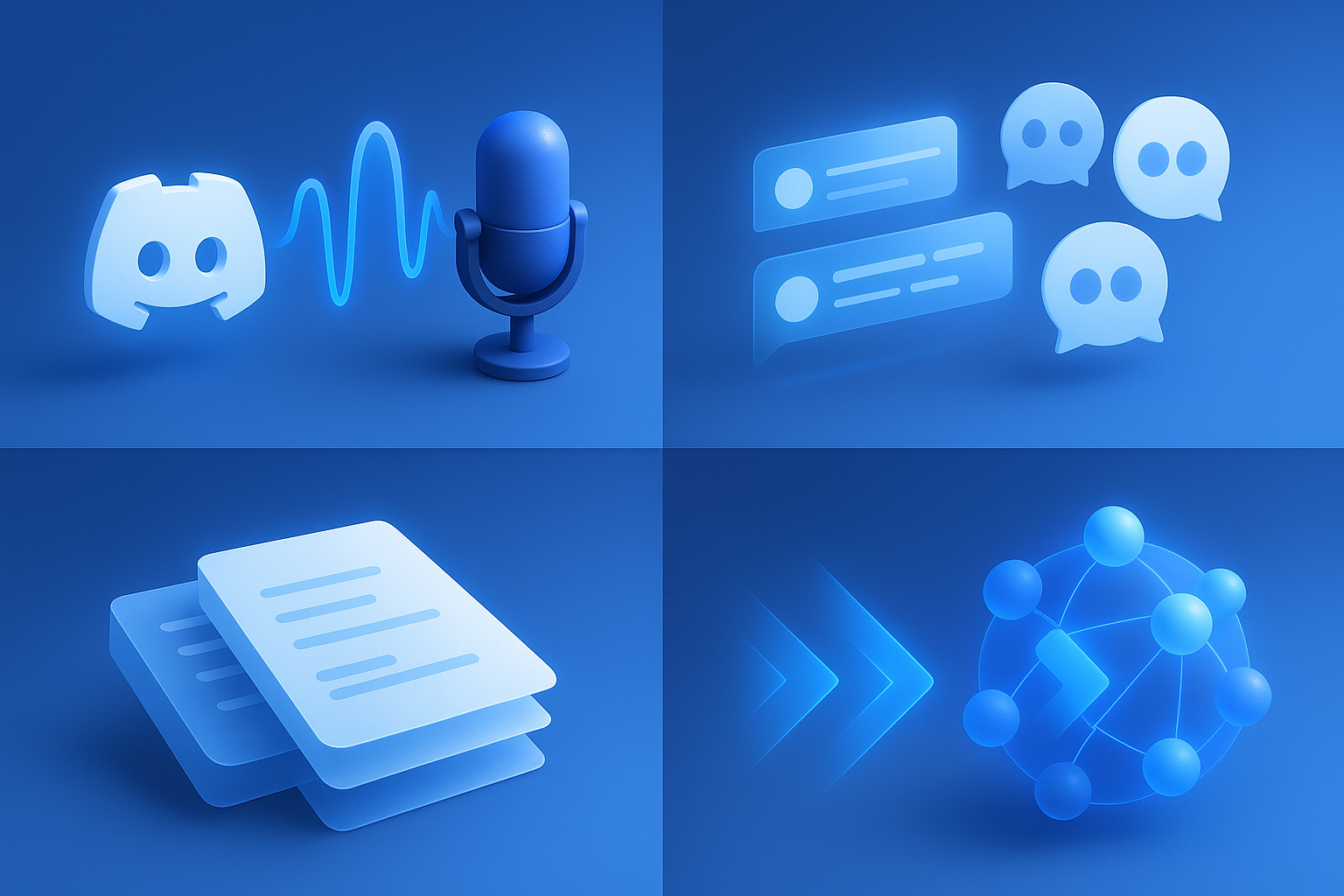
Turning a Discord voice call into a queryable knowledge base involves five stages.
Audio capture – A bot joins the voice channel and records each participant on a separate track.
Transcription – Speech to text converts audio into text. Diarization, the process of determining who said what, attributes each segment to a speaker.
Summarization – A language model condenses the transcript into key points, decisions, and action items.
Embedding – The transcript is converted into vector representations and stored in a database optimized for semantic similarity.
Retrieval – When you ask a question, the system matches your query embedding against stored vectors and returns the most relevant passages.
Recall.ai offers transcription at $0.15 per hour, covering both real time and asynchronous modes. For multi talker environments, research on Diarization Conditioned Whisper shows that speaker attributed models can achieve lower concatenated minimum permutation word error rates by jointly decoding overlapping speech.
Key takeaway: Accurate diarization is the foundation; without it, retrieval cannot attribute quotes to the right person.
Command bots vs. conversation: where do most Discord note-takers fall short?
Legacy Discord bots rely on slash commands for every interaction. Start recording with /join, stop with /leave, customize with /config. This works for basic capture, but retrieval stays manual.
| Capability | Command Driven Bots | Conversational Bots |
|---|---|---|
| Start and stop recording | Slash commands like /join and /leave | Same or voice activated |
| Retrieve specific moments | Keyword search or scroll | Natural language query |
| Semantic understanding | None | Vector similarity matching |
| Cross meeting context | Manual comparison | Unified index |
A GitHub project called Discontext demonstrates the semantic approach. It uses OpenAI's ada model to generate embeddings for each message and stores them in a vector database. Users can find messages based on meaning rather than exact phrasing. The limitation is that it cannot index messages created before the bot was added.
Scribe, another Discord tool, offers structured command interactions for transcribing tabletop role playing sessions, but querying still requires navigating to a web dashboard and searching manually.
"I only started this project because I wanted to learn about word embeddings and vector databases, so I'm not sure if I'll ever finish it," the Discontext creator noted on GitHub. The comment highlights a common gap: experimental projects demonstrate feasibility, but production grade natural language search requires sustained engineering.
Key takeaway: Slash commands handle capture; conversation handles retrieval.
How Harmony's AskHarmony turns Discord transcripts into chat-ready knowledge
Harmony was built specifically for Discord voice channels. The bot joins with /record, captures multi channel audio, and produces speaker attributed transcripts. What sets it apart is AskHarmony, a conversational interface that lets users query meeting content in plain English.
Ask "What decisions did we make about the launch?" and AskHarmony returns the exact clip and summary. The system supports 57 plus languages, making it practical for global teams and multilingual communities.
"Most of our team comms are on Discord and we always needed an AI note taker. Game-changer for our team and we use Harmony everyday!" — Harmony user testimonial
Setup takes about two minutes:
- Invite the Harmony bot to your server.
- Type
/recordin a voice channel to start capturing. - Type
/stopto finish and begin processing.
The web dashboard stores unlimited transcript history, provides speaker analytics, and exposes the AskHarmony chat. A free tier includes 60 minutes of transcription per month; the Pro plan at ten dollars per seat adds 600 minutes and priority support.
How do you engineer natural-language retrieval for accuracy and speed?
Deploying vector search for meeting transcripts involves balancing memory, latency, and precision.
Estimate RAM requirements – A common formula is number of vectors times dimension times four bytes times 1.5. For one million 1024 dimensional vectors, expect roughly six gigabytes.
Choose real time or batch – Real time transcription delivers results as the meeting progresses, but post call transcription yields higher quality because the model has full context.
Tune HNSW parameters – Vector databases like Qdrant incrementally build an HNSW index as data arrives. Setting the
mparameter to zero during bulk upload disables indexing and speeds ingestion.Pre filter with metadata – Attach speaker, date, and channel tags to each chunk so queries can narrow scope before semantic matching.
Use quantization for scale – Vector quantization compresses embeddings, allowing more of them to fit in memory and reducing disk reads.
Research on proactive search in conversations, published in a 2025 arXiv paper, introduced Conv2Query, a framework that maps conversational context into ad hoc queries. The approach significantly improves retrieval performance by bridging the gap between how people phrase questions and how documents are indexed.
Key takeaway: Optimizing retrieval is as important as optimizing transcription; slow search erases the productivity gains.
From queries to agents: the next leap for meeting intelligence
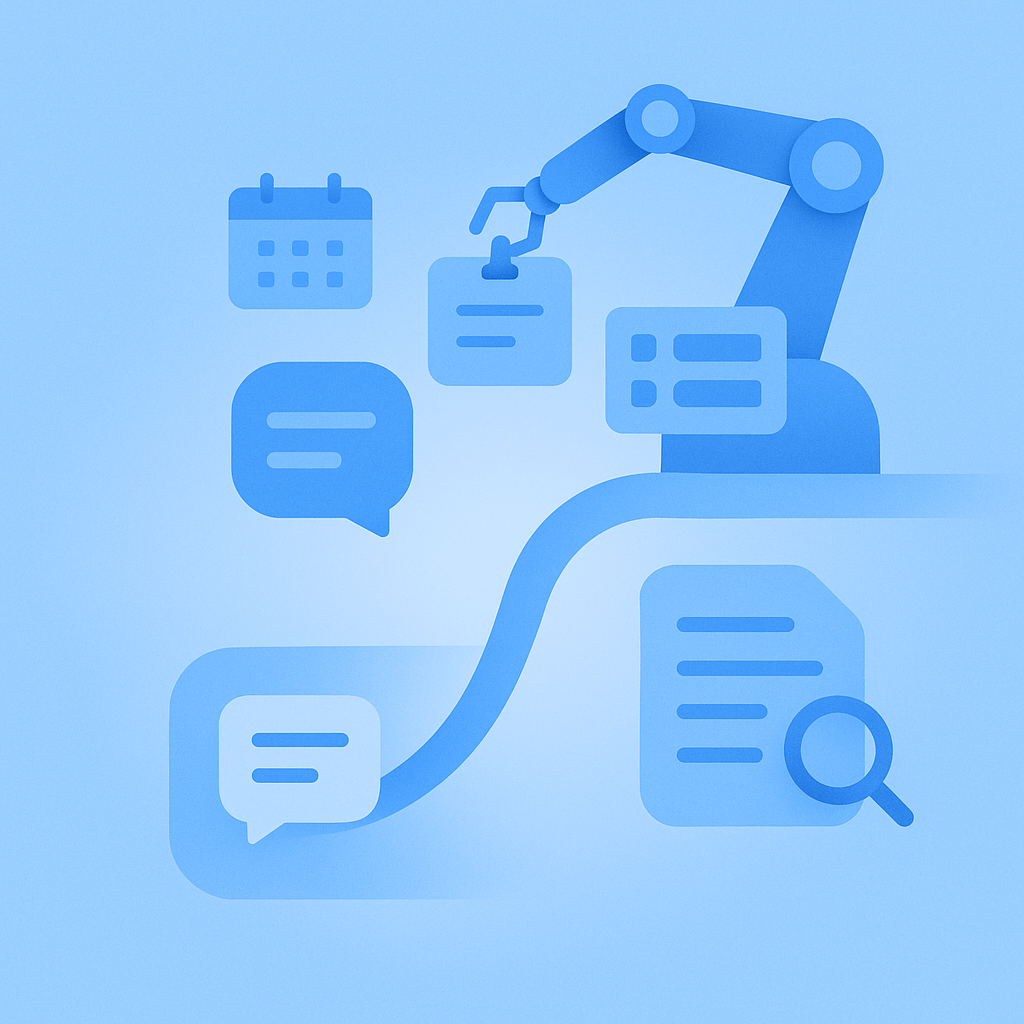
Natural language query is a stepping stone. The next frontier is agentic AI, systems that do not just answer questions but execute multi step workflows.
McKinsey research describes the shift: "We are beginning an evolution from knowledge-based, gen-AI-powered tools—say, chatbots that answer questions and generate content—to gen AI–enabled 'agents' that use foundation models to execute complex, multistep workflows across a digital world." — McKinsey
In the meeting context, an agent could surface action items, create tickets in your project tracker, and draft follow up messages without manual intervention. Agentic AI is expected to power more than 60 percent of the increased value from AI deployments in marketing and sales.
For Discord communities, this means future bots might not only answer "What did we decide?" but also update pinned messages, assign roles based on commitments, and schedule the next meeting.
Achieving business value with agentic AI requires changing workflows, not just adding tools. Organizations that redesign processes around AI collaboration see the largest gains.
Key takeaway: The query layer is foundational; agents will build on it to automate entire meeting workflows.
Takeaways: make every Discord conversation instantly searchable
Discord meeting notes become valuable only when you can find what you need without rewatching the entire call. Natural language search turns transcripts into living documentation.
- Start with accurate transcription and speaker diarization.
- Embed transcripts in a vector database for semantic retrieval.
- Use a conversational interface to query across meetings.
- Plan for agents that will automate post meeting tasks.
Harmony delivers this stack out of the box for Discord. With 6,000 users already relying on AskHarmony, the platform proves that natural language retrieval is not a research project but a production ready feature. Invite the bot, record your next standup, and ask it what you discussed. The answer is already there.
Frequently Asked Questions
What is the main advantage of using natural language AI for Discord meeting notes?
Natural language AI allows users to query meeting content in plain English, retrieving specific information quickly without needing to remember exact phrases or manually search through transcripts.
How does Harmony's AskHarmony feature enhance Discord meeting productivity?
AskHarmony enables users to query meeting transcripts using conversational language, turning them into searchable knowledge. This reduces the time spent searching for information and helps teams follow up on action items more efficiently.
What are the key components of an AI workflow for Discord meeting notes?
The AI workflow involves audio capture, transcription, summarization, embedding, and retrieval. Each stage transforms voice calls into a queryable knowledge base, with accurate diarization being crucial for attributing quotes to the right speakers.
How does Harmony differentiate from other Discord bots?
Harmony is specifically designed for Discord, offering a conversational interface for querying meeting content. It supports multiple languages and provides speaker-attributed transcripts, making it ideal for global teams and multilingual communities.
What future advancements are expected in AI meeting tools?
The next leap involves agentic AI, which will not only answer questions but also execute multi-step workflows, such as creating tickets or drafting follow-up messages, further automating meeting processes.
Sources
- https://harmonynotetaker.ai/
- https://www.scribbl.co/post/how-to-use-ai-to-take-meeting-notes-guide#:~:text=Bottom%20line%20for%20Discord:%20If,takers%20to%20capture%20voice%20discussions.
- https://slack.com/blog/productivity/ai-meeting-note-taker-how-it-works-and-features-to-look-for
- https://assemblyai.com/blog/top-ai-notetakers
- https://www.mckinsey.com/capabilities/quantumblack/our-insights/the-state-of-ai
- https://docs.recall.ai/docs/transcription
- https://docs.recall.ai/docs/recallai-transcription
- https://arxiv.org/html/2510.03723v1
- https://github.com/f0lio/discontext
- https://www.scribebot.ai/help
- https://qdrant.tech/documentation/cloud/capacity-sizing/
- https://arxiv.org/pdf/2506.00983
- https://www.mckinsey.com/capabilities/tech-and-ai/our-insights/why-agents-are-the-next-frontier-of-generative-ai
- https://www.mckinsey.com/capabilities/growth-marketing-and-sales/our-insights/agents-for-growth-turning-ai-promise-into-impact
- https://www.mckinsey.com/capabilities/quantumblack/our-insights/one-year-of-agentic-ai-six-lessons-from-the-people-doing-the-work